

×

Tuningi Newsletter March 2007

news_01news_02news_03

Hello again to all of you!

We hope that all of you are getting ready for the Easter holidays and that most of you are planning to spend it in the lovely Madikwe. We also hope that some of you are coming to visit us here in Tuningi, in particular. It is a real honour for us to entertain return guests over and over again, or to hear that people have come to visit us on recommendation by their friends or family.

We still have not had any rain, but have not lost hope yet, as the clouds have been building up over the last couple of days every afternoon. This might just result in a nice thunderstorm that can fill the dams and waterholes to see us through winter.With the bush this dry already, the game viewing has been quite spectacular over the last month. The grass is very short for this time of the year and the animals congregate around the water holes as there is still more green grass and foliage around the wet areas.

We know very well that, even if we offer the guest the best ever accommodation, food and service, the game lodge experience is not complete if the game viewing is not up to standard. For this reason we employ rangers that are not only acute observers and communicators, but also true naturalists with a passion for the living world. Guests at Tuningi are afforded the opportunity to share in their intimate wisdom and understanding of nature.

In March, our rangers showed our privileged guests a great time as usual.

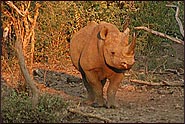
The elusive black rhino was seen at Inkwe pan often. As they are still on the endangered species list, it is always most exciting to see them.

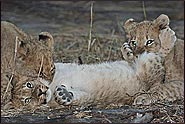
Last year in July, one of the female lions had three beautiful lion cubs, which we saw all the time. We were very worried about them, as lion cubs often get killed by other lions, hyenas or wild dogs, but we are relieved to report, that she has been a great mother so far and that we still have the privilege to bump into them every now and then.

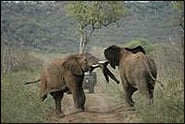
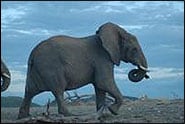
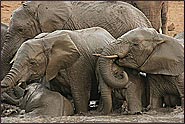
Although there is not a lot of water in the pans and dams at the moment, the elephants still entertain us on game drives with their extravagant bath displays. You can watch for hours as they play with each other and roll around in the mud. Some of the dams are fed by boreholes, and the elephants know exactly where the fresh water runs from the pipe. The older bulls insist on drinking only the pure water from the pipe, which causes a lot of drama, pushing, shoving and noise. Great game viewing!

A leopard sighting is always unbelievably exhilarating.

Leopards are widespread throughout South Africa , and the only large cats able to survive outside protected areas. Being solitary and primarily nocturnal ( and able to subsist on small prey) they can go about their life mostly undetected in comparison to lion who are group living and in need of large prey, or cheetah, who are diurnal (active during the day).

An estimated 15 to 30 leopards were enclosed within the boundary of Madikwe Game Reserve when it was established in 1991. It takes a lot of luck, skill, and patience to track a leopard, but sometimes we just happen to be at the right place at the right time. These are moments never to be forgotten. Every time a leopard is spotted in the reserve, excitement grows, because the more these skittish cats get exposed to the game vehicles, the more relaxed they will become around them. This will result in them becoming more confident around vehicles and less likely to shy away from them.

This month we had an awesome sighting of a leopard with her three cubs at Chlou dam. This happened while we were parked on the dam wall, watching, elephant, buffalo and rhino. You must think that this is too good to be true, but it was just one of those fantastic moments in our lives!

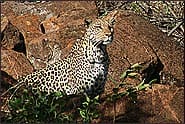
We also often see a beautiful leopard, hiding in the rocks in the Inselbergs. It takes a practiced eye to spot him, though.

We received a fantastic gift from our dear friend Hilary Wylie this month. She bought Tuningi a surveillance camera to put up at our water hole. This camera now sends the images of what is happening at the water hole to a TV screen in the bar. For the first time we are now able to see who has visited us while we were not looking. We can also keep an eye on the water hole at any time while we are in the bar area and alert the guests to go and see the action first hand. This is extremely exciting, for the elusive leopard usually comes to drink when nobody is watching.

The game drives are definitely not just about chasing after the big and dangerous stuff! Our guides will teach you about termites and butterflies and squirrels and stars and moths and birds and grass and trees and, and, and….

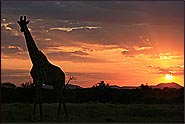
They will also show you the most unforgettable African sunsets in the world!

Well, we can carry on for ever, but will rather chat to you again after the Easter holidays. Happy egg hunting, and all of the best to you!

Kindest regards

The T-team

For enquiries please contact :

reservations@madikwecollection.com
news_04news_05news_06

Tuningi Newsletter February 2007

news01news02news03
Warm greetings to you all once again from a scorching hot month in Madikwe.

We have had a wonderful, busy month at the lodge and once again feel incredibly privileged to have been in the position to meet so many fabulous people.

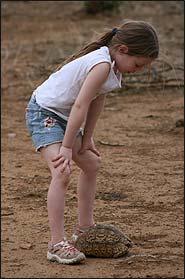
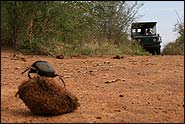
As usual we had a lot of children visiting us, and as you all know by now, we make it our business to educate them about Nature and all the small things bright and beautiful out there. For those , too small to sit through the long hours of a game drive, we have made a special ‘play room’ full of interesting things to play with. Those on game drives get very special treatment from the rangers who all adore children, stopping and giving attention to even the smallest creatures in the veld, like dung beetles, tortoises, guinea fowl and dragon flies. The little ones get to go on there own short drives to Inkwe pan and back, gathering feathers, dung, rocks and other things to use for our treasure hunts.

Come meal times, we organize special Boma barbeques for the kids and teach them to bake bread on sticks over the fire. We also have pizza making, story telling and star gazing evenings. While all this is happens, mom and dad can have a romantic dinner on their deck and really experience the romance of the African Bush.

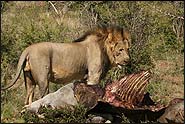
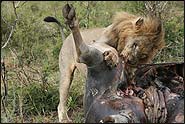
The greatest excitement of this month was caused by the two huge lion brothers, Ditaba and Sipedi, who killed an enormous Eland bull, almost on the lodge’s door step.

How privileged we were to be able to see the whole process of how Nature works. It is truly mind blowing to even imagine how much strength it must take for a lion of about 180kg, to pull down an ox-like creature, the largest African antelope, of between 700 and 800kg, even with the help of his brother of another 150 kg. Well, let me tell you, these two big cats had a feast of a life time after this great accomplishment.

The first night, after the kill, they kept dead quiet and just ate and ate until they were almost ready to explode. By the second night, they were still eating, but started roaring madly every ten or twenty minutes to let the whole of Madikwe know that no matter how full their stomachs were, they were not about to share even a tiny little morsel with anybody…. Not even the rest of their extended lion family.

By day three, the jackals, hyenas and vultures started to gather on the outskirts taking great care not to get too close to the two, by now obese, lazy kings of the bushveld. They were still guarding the rest of the, terribly smelly heap of meat from a distance, but started showing signs of moving on. At this stage, they would still give a big roar, here and there, but managed to do so without even lifting a head. They truly had had enough to eat!!!!

This is where Nature tells its story best.
With this rotting peace of meat, lying in the sun for days on end, one would expect terrible disease to spread rapidly through the area. Mother Nature, however does not allow this to happen. She promptly sends in the vacuum cleaners of the bush.

First came the jackals, known to have cast-iron stomachs, who pick at the last bits of the rotting, putrid meat. Then enter the hyenas. They have a massive scull with a prominent medial crest to anchor muscles that empower their jaws. This enables them to eat and digest bones, horns, and even teeth. They are also the only carnivores that eat skin and hides, just to disgorge the indigestible hair at a later stage.

While this is all going on, hundreds of vultures gather in the trees around the rotting carcass to wait their turn to complete the cleansing job.
For this purpose, each type of vulture has a different feature.
The Lapped faced vulture, for instance, has a very strong beak for opening up the pieces of the carcass that is still covered with hide.
The Cape vulture and White Backed vulture has an unusually long neck, enabling it to stick its head deep into the carcass and clean the bones from the inside.
The Hooded vulture on the other hand, has a fine precision beak for getting to the tiny bits and pieces still clinging to the bones right at the end of the whole process.
All of these vultures can digest even the most horrifyingly rotten meat, as they have acidic digestive systems, leaving the piece of the bush ,which only days ago, smelt like death, cleaned up and disease free.

How utterly amazing Nature is !!

Book your next holiday at Tuningi as soon as possible! You will be amazed by the pure exhilaration of it all.

Can’t wait to see you, spoil you, enlighten you, befriend you……..

The T-team

news04news05signaturepic

Tuningi Newsletter January 2007

safari1safari2safari3

Warm greetings to all of you once again!

We hope that you all had a wonderful long holiday and that you are now happily settled back into your normal daily routine.

We also hope that you will soon start dreaming about your next African Safari.
Before you decide on where you will be going, please read the letter below that we took off two of our guests’ web site. They stayed with us for five days in the last week of December 2006.

We would like to thank Matt and Vanessa for sharing this with all of us and we hope that it will inspire those of you who have been here before, to come back and those of you who are still thinking about it, to pick up the phone and make that booking!

Safari…in Madikwe Africa
December 29, 2006
11 PM

Going on safari has certainly been one of those amazing life experiences that we will remember for a long time. Observing the animals in a natural setting is extraordinary, but seeing them in their environment adds that extra dimension. Once outside the confines of the lodge or off the vehicles, our lives were at risk from any number of species – lion, leopard, elephant, rhino, mambas, puff adders, cobras and scorpions to name a few. Without the professional guidance of our rangers, even the vehicles would not protect us from many of them if tell-tale warning signs were ignored or misunderstood. It is sobering and somewhat awe-inspiring to suddenly become one of the “lesser” species in a raw Darwinian environment.

In a similar vein to our Alaska trip last year, once inside the reserve there was little to link you to the modern world. There were no televisions, no radios and no cell phones – only the noises of the bush, the brilliant starry skies and a very thin wire surrounding the lodge separating us from “the wild”. There is a solitude and tranquility that develops almost immediately….so much so that after five days away we were a bit overwhelmed when we returned to the regular hustle and bustle of our hotel in Johannesburg.

Madikwe is a 75,000 hectare game reserve in the north-west of South Africa bordering Botswana. This park is particularly noteworthy in that it was designed specifically to provide opportunities in an underdeveloped area of the country while promoting animal conservation. It is a joint venture between the government, private industry and most importantly the local communities. To establish the park, degraded farming areas were cleared, a perimeter fence was erected and the largest game relocation in history was undertaken to transfer around 10,000 animals into the park. It is joint managed, and by all accounts appears to be a resounding success for both the local communities and of course the animals!

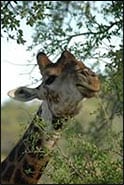
We were fortunate enough to see the “Big Five” (elephant, lion, leopard, rhino and buffalo) as well as the very rare African Wild Dog which is one of the features of Madikwe. However, every day was like a lottery – and whilst seeing the big five was exhilarating, the gentle grazing of a giraffe, the frenzied jumping of bush babies and the laboring of a dung beetle could be just as rewarding.

Bush Transport
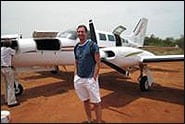
Our transit to Madikwe was also a “first” for us. Not only did we have a private plane to take just the two of us there, but it was also a private 6-seater plane. It was extraordinarily personal flying in something not much larger than an SUV . It’s difficult to describe the thrill of flying low over miles of bush that you know is teeming with big game. Landing was pure adrenalin as we banked sharply before skidding left and right along a short dirt strip cut out of the bush. The “arrival lounge” was a large tree under which a safari vehicle was parked.

Nkwe Tracking
The elusive leopard (“nkwe” in local Tswana language) was a major attraction and on one occasion, after much searching, we spotted a large male stealing off and blending into the bush. Gavin and Johann rapidly piled us all into one vehicle and we bounced off road trailing the graceful cat until it decided to lose us, somewhat oblivious to our attentions. It was thrilling being on the “hunt” (modern-day photography style) and when we lost the trail, we returned to a nearby tree to find two dead wildebeest calves carefully placed in a high branch for a future meal. Along with our lion and elephant encounters, the sight of the poor calves was a sharp reminder than we weren’t in a zoo.

The Safari Experience
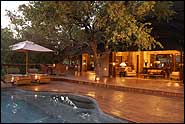
Our lodge Tuningi was a very small and personal outfit with space for only 16 guests. Gavin, Quentin, Heidi, Benny and the team made us feel like part of an extended family, and we enjoyed the company of the other guests. Deep baths overlooking the bush, outside showers, delicious meals and friendly staff made each day a luxurious pleasure. However, comforts aside, the safari routine itself was unexpectedly tiring.

The morning starts at 5:15am so that you can depart at dawn for your first game drive of the day. Coffee is usually served somewhere spectacular in the park following by a huge breakfast sometime later in the morning back at the lodge. Between breakfast and high tea you basically sleep, read, swim or just laze around taking in the sights and sounds of the bush. The waterhole at the lodge is regularly frequented by wildlife so the safari continues even while resting. Late afternoon you depart for your second game drive which ends at nightfall, but is broken up by extremely civilized sundowner drinks somewhere within the park. Often dinner is served in the “Boma”, an enclosed and elevated area close to the waterhole under a huge fig tree after which the lodge is named. A roaring wood fire, paraffin lanterns and local folk songs sung by the staff make it a pretty magical experience, especially when a large herd of elephants wanders by to drink and play.

A wonderful experience and something we intend to repeat in the future.
Matt Tottenham and Vanessa Butler

We hope that you enjoyed their encounters at Tuningi! If you want to chat to them you can find them on www.tottler.com

We wish you all highly successful 2007, and a year full of love and happiness!

Until we meet again
The T-team

Dunelle@madikwecollection.com

safari4safari5safari6